Stainless steel is widely used for water storage because of its strength, durability, and resistance to corrosion. However, not every stainless steel grade performs in the same way.
Two of the most common grades are 304 and 316 stainless steel. They look very similar, and both can be used in water-related applications. Their resistance to certain types of corrosion, however, is different.
This difference becomes particularly important for water tanks exposed to chlorides, coastal conditions, industrial environments, or challenging water chemistry.
So, which is better for a water tank: 304 or 316 stainless steel?
There is no single answer for every application. The right choice depends on the stored water, surrounding environment, tank design, fabrication quality, and expected operating conditions.
This guide compares 304 vs 316 stainless steel and explains what to consider when selecting materials for water storage tanks.
What is 304 Stainless Steel?
304 stainless steel is one of the most widely used austenitic stainless steel grades. Its composition includes chromium and nickel. These alloying elements help create the corrosion resistance associated with stainless steel.
Chromium is particularly important because it helps form a thin passive layer on the surface. This layer protects the underlying metal from many common forms of corrosion.
If the surface remains in suitable conditions, the passive layer can reform after minor damage.
304 stainless steel combines several useful characteristics, including:
- good general corrosion resistance;
- good formability;
- good weldability;
- durability;
- relatively easy fabrication;
- suitability for many water-related environments.
For these reasons, 304 stainless steel is used across numerous industries and applications. However, “stainless” does not mean completely immune to corrosion.
Its performance depends heavily on the environment in which it is used.
What is 316 Stainless Steel?
316 stainless steel is also an austenitic stainless steel. Like 304, it contains chromium and nickel. The important difference is the addition of molybdenum. Molybdenum improves resistance to certain forms of localised corrosion, particularly in environments containing chlorides.
This makes 316 stainless steel particularly useful where equipment may be exposed to:
- coastal conditions;
- salt;
- chloride-containing water;
- some industrial environments;
- more aggressive chemical conditions.
For water storage applications, this additional corrosion resistance can be an important advantage. However, 316 stainless steel is generally more expensive than 304.
It is also important to understand that 316 is not corrosion-proof. It can still deteriorate when exposed to unsuitable conditions.
What is the Difference Between 304 and 316 Stainless Steel?
The most important practical difference is corrosion resistance. Both grades perform well in many environments, but 316 generally offers greater resistance to chloride-related corrosion because of its molybdenum content.
Here is a simple comparison:
| Factor | 304 Stainless Steel | 316 Stainless Steel |
|---|---|---|
| General corrosion resistance | Good | Very good |
| Chloride resistance | Moderate | Higher |
| Molybdenum | Typically absent | Present |
| Coastal applications | Requires careful assessment | Often better suited |
| General water storage | Commonly used | Commonly used |
| Aggressive environments | More limited | Better resistance in many conditions |
| Cost | Generally lower | Generally higher |
| Appearance | Very similar to 316 | Very similar to 304 |
This does not mean that 316 should automatically replace 304 in every tank. If 304 is appropriate for the water chemistry and operating environment, using 316 may provide limited practical benefit relative to the additional cost.
Material selection should therefore be based on actual service conditions.
304 vs 316 Stainless Steel for Water Tanks
Both 304 and 316 stainless steel can be used for water storage tanks. The better option depends on what the tank stores and where it operates.
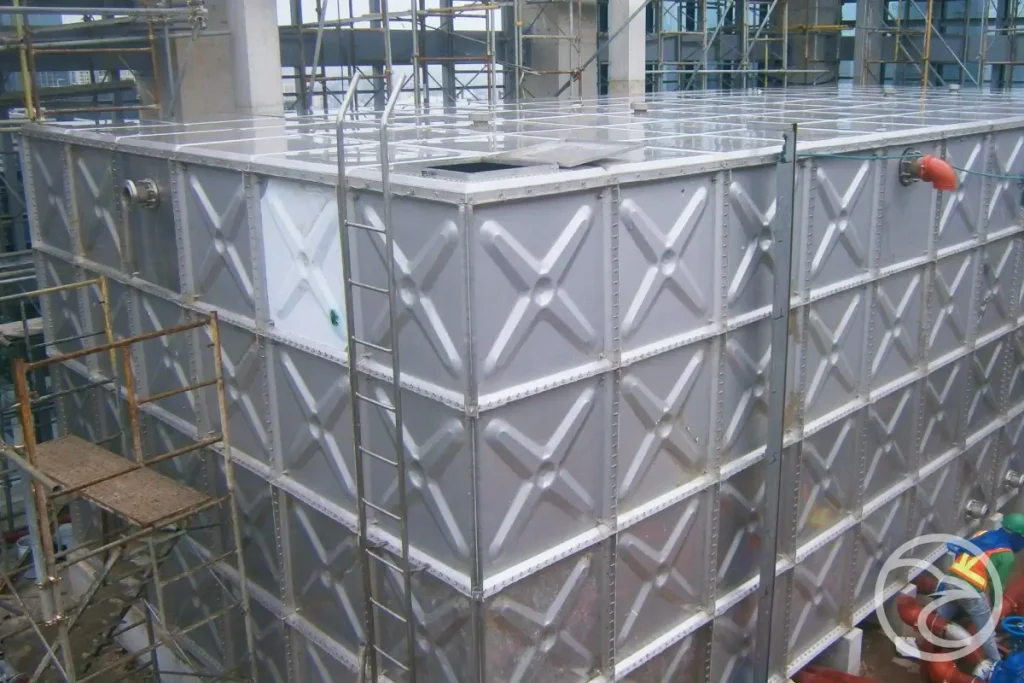
Several factors should be considered. For applications requiring modular construction and durable corrosion-resistant materials, stainless steel sectional tanks can provide a flexible water storage solution for a range of site conditions.
Water Chemistry
Water is not chemically identical from one site to another. Chloride concentration, pH, temperature, dissolved substances, and treatment chemicals can all influence corrosion behaviour.
A grade suitable for one water source may not necessarily provide the same performance under different conditions.
Tank Location
The external environment matters too. A tank located inland in a relatively mild environment experiences different conditions from a tank close to the ocean. Airborne salt can increase chloride exposure on external surfaces.
Industrial sites may introduce additional contaminants.
Operating Temperature
Temperature can affect corrosion behaviour. A material that performs adequately under one combination of water chemistry and temperature may behave differently as conditions become more aggressive.
Tank Design
Material grade is only one part of corrosion resistance.
Tank performance can also be influenced by:
- joints;
- welds;
- penetrations;
- drainage;
- surface finish;
- crevices;
- connections;
- fabrication quality.
Choosing a more corrosion-resistant grade does not compensate for poor tank design or fabrication.
Maintenance
Inspection and maintenance also affect long-term performance. Deposits, surface contamination, damaged components, and developing corrosion should be identified before deterioration becomes extensive.
The decision between 304 and 316 therefore needs to consider the complete tank environment rather than material grade alone.
Is 304 Stainless Steel Good for Water Tanks?
Yes, 304 stainless steel can be a suitable material for many water tank applications. It provides good general corrosion resistance and is widely used where operating conditions are compatible with the material.
However, suitability should be determined for the specific application.
Important considerations include:
- chloride levels;
- water chemistry;
- external environment;
- tank temperature;
- cleaning chemicals;
- fabrication;
- expected maintenance;
- applicable water storage requirements.
A common mistake is to assume that 304 stainless steel is appropriate for every type of water simply because it is stainless steel.
That is not the case. In environments with elevated chloride exposure, the risk of localised corrosion can increase. Under those conditions, 316 may provide an advantage.
Does 304 Stainless Steel Rust?
304 stainless steel can corrode. It is much more corrosion-resistant than ordinary carbon steel in many environments, but it is not completely resistant to all forms of corrosion.
Several conditions can contribute to deterioration.
Chloride Exposure
Chlorides are particularly important when assessing stainless steel. They can contribute to localised forms of corrosion, including pitting and crevice corrosion.
The level of risk depends on several factors rather than chloride exposure alone.
Deposits
Sediment and other deposits can create local conditions that differ from clean, exposed surfaces. They can also make deterioration underneath harder to detect during inspection.
Surface Contamination
Contamination during fabrication, installation, maintenance, or nearby work can compromise the expected performance of a stainless steel surface.
Crevices
Small gaps around connections, joints, fasteners, and other components can create conditions where localised corrosion is more likely.
Unsuitable Chemicals
Cleaning and maintenance chemicals need to be compatible with the material. Using an unsuitable product can damage stainless steel rather than protect it.
Therefore, visible rust on a 304 stainless steel tank should not automatically be dismissed as normal. Its source and extent should be investigated.
Can 316 Stainless Steel Rust?
Yes. 316 stainless steel offers greater corrosion resistance than 304 in many chloride-containing environments, but it is not completely immune to corrosion.
Problems can still develop due to:
- severe chloride exposure;
- inappropriate chemical exposure;
- deposits;
- crevices;
- surface contamination;
- poor fabrication;
- unsuitable welding practices;
- damaged surfaces;
- inadequate maintenance.
This is an important distinction. 316 should be considered more corrosion resistant in many relevant environments, rather than corrosion-proof.
A 316 tank still requires appropriate design, fabrication, inspection, and maintenance.
304 vs 316 Stainless Steel for Drinking Water
Both 304 and 316 stainless steel are used in equipment associated with water. However, choosing stainless steel for drinking water storage involves more than comparing two grade numbers.
The selection should consider:
- water chemistry;
- chloride concentration;
- temperature;
- tank construction;
- weld quality;
- fittings and associated materials;
- cleaning procedures;
- applicable potable water requirements.
In less aggressive environments, 304 may provide suitable performance. Where chloride exposure or other corrosion risks are higher, 316 may offer additional protection.
However, the material grade alone does not determine whether an entire tank system is suitable for potable water.
Seals, fittings, coatings where present, fabrication materials, and other components also need to be appropriate for the intended application.
304 vs 316 Stainless Steel for Fire Water Tanks
Fire water tanks present another set of considerations. Water can remain stored for long periods, and tank condition must be managed throughout its service life.
When choosing between 304 and 316 stainless steel for a fire water tank, factors may include:
- water chemistry;
- chloride exposure;
- site environment;
- coastal proximity;
- internal conditions;
- external exposure;
- tank design;
- maintenance requirements;
- expected service conditions.
Neither grade eliminates the need for inspection. Internal surfaces, welds, joints, penetrations, roof components, and other areas should still be monitored for deterioration.
Stored water conditions should also be considered. Sediment and corrosion products can provide useful clues about changes occurring inside a tank.
The most appropriate stainless steel grade should therefore be selected as part of the wider tank design rather than as an isolated specification.
304 vs 316 Stainless Steel for Wastewater
Wastewater applications require particularly careful material selection. The term “wastewater” covers a wide range of chemical conditions.
Two wastewater tanks may contain completely different concentrations of chlorides, chemicals, dissolved substances, and contaminants.
For this reason, it is not accurate to say that 304 is always suitable or that 316 is automatically sufficient. The selection should consider the actual characteristics of the stored liquid.
Relevant factors can include:
- chloride concentration;
- pH;
- temperature;
- dissolved chemicals;
- industrial contaminants;
- cleaning processes;
- expected exposure time.
316 may offer better performance in some more corrosive environments, but specific wastewater chemistry still needs to be considered.
Which Stainless Steel is Better for Coastal Environments?
316 stainless steel is often preferred where chloride exposure is an important concern. This makes it particularly relevant for coastal environments.
Salt carried in sea spray and airborne moisture can settle on exposed tank surfaces. Over time, this can create more aggressive conditions for stainless steel. 304 can still perform well in many environments, but coastal exposure may increase the likelihood of staining or localised corrosion.
The actual risk depends on factors such as:
- distance from the coast;
- direct salt spray exposure;
- prevailing weather;
- rainfall and natural washing;
- sheltered surfaces;
- maintenance;
- surface finish;
- tank orientation.
For tanks located in strongly chloride-exposed environments, the improved resistance of 316 can justify its additional cost. Material selection should still be based on the actual site rather than location alone.
Is 316 Stainless Steel Stronger than 304?
Not necessarily in the way this question is commonly understood. The main reason for choosing 316 instead of 304 is usually corrosion resistance, not simply greater strength. Both grades can provide suitable mechanical properties for many applications.
Structural performance depends on more than the grade name.
It can also depend on:
- material thickness;
- tank dimensions;
- panel design;
- structural supports;
- connections;
- fabrication;
- loading conditions.
For a water tank, it is therefore useful to separate two questions:
Is the material structurally suitable?
and Is the material sufficiently corrosion resistant for the environment?
They are related, but they are not the same question.
How can You Tell 304 and 316 Stainless Steel Apart?
304 and 316 stainless steel can look almost identical. It is generally not reliable to determine the grade simply by looking at the surface. Both can have similar finishes and appearances.
Where grade verification is important, identification may involve:
- material certificates;
- fabrication records;
- supplier documentation;
- appropriate material identification testing.
This becomes particularly important during repairs, modifications, or replacement works. Installing an unidentified or incompatible material can create problems even when the replacement component looks identical to the original.
For existing tanks where records are unavailable, appropriate testing may be required before making decisions based on the assumed stainless steel grade.
What Causes Stainless Steel Water Tanks to Corrode?
Stainless steel tanks can develop corrosion even when the original material grade was appropriate. Understanding the cause is essential before deciding how to repair the problem.
Chlorides
Chlorides can increase the risk of localised corrosion. They may come from stored water, the surrounding environment, cleaning products, or industrial processes.
Crevice Conditions
Narrow gaps can develop around joints, washers, connections, penetrations, and other components. These areas can behave differently from freely exposed stainless steel surfaces.
Deposits and Sediment
Deposits can obscure the metal surface and make early deterioration difficult to identify. If unusual rust particles or corrosion products are found inside the tank, their source should be investigated.
Dissimilar Metals
Connections between different metals need careful consideration. Under suitable conditions, galvanic interactions can contribute to localised deterioration.
Surface Contamination
Stainless steel surfaces can become contaminated during fabrication, installation, grinding, maintenance, or nearby work. Good material handling and fabrication practices are therefore important.
Welding and Fabrication
Welded areas require appropriate procedures and finishing. Poor fabrication can reduce corrosion performance around affected areas.
Poor Drainage
Water that remains on external surfaces can create prolonged wet conditions. Roof areas, joints, edges, and other locations where water collects should therefore be monitored.
Does Stainless Steel Grade Affect Tank Maintenance?
Yes, but the grade does not remove the need for maintenance. A tank made from 316 stainless steel still needs condition monitoring. Likewise, a correctly specified 304 tank can provide long-term service when environmental conditions remain appropriate and developing defects are addressed.
A maintenance program may consider:
- visible corrosion;
- surface contamination;
- joints;
- welds;
- fasteners;
- roof condition;
- sediment;
- drainage;
- penetrations;
- previous repairs.
Maintenance records are also valuable because they show whether the same areas repeatedly require attention.
What Should be Checked During a Stainless Steel Tank Inspection?
Inspection should consider the tank as a complete structure rather than looking only for visible rust. Important areas can include:
Tank Walls
Inspectors may look for staining, pitting, deformation, damaged surfaces, and other visible deterioration.
Welds and Connections
Welds, joints, bolts, and connections can create local conditions different from open surfaces. These areas deserve particular attention.
Tank Roof
The roof is exposed to weather and may experience standing water, contamination, or localised corrosion. Hatches, vents, penetrations, and roof connections should also be considered.
Tank Floor
Internal floors can collect sediment and deposits. Where deposits obscure the surface, further assessment or cleaning may be required before the floor condition can be properly evaluated.
Penetrations and Fittings
Connections around pipes and fittings should be checked for signs of leakage, corrosion, or deterioration.
Internal Surfaces
Where internal assessment is possible, inspectors can look for pitting, deposits, staining, corrosion products, and other changes. Professional Tank Inspection Services can help determine whether visible stainless steel deterioration is localised or indicates a broader tank condition issue.
304 vs 316 Stainless Steel: which Should You Choose?
There is no universal winner. The correct choice depends on the application.
304 Stainless Steel may be Suitable When:
- the environment is relatively mild;
- chloride exposure is limited;
- stored water chemistry is compatible;
- site conditions are appropriate;
- the tank is properly designed and fabricated;
- inspection and maintenance are planned.
Its lower material cost can make 304 an efficient choice where the additional corrosion resistance of 316 is not required.
316 Stainless Steel may be Preferred When:
- chloride exposure is higher;
- the tank is located in a coastal environment;
- stored water creates more demanding corrosion conditions;
- the site has aggressive industrial exposure;
- additional resistance to localised corrosion is desirable.
The higher initial cost may be justified where it reduces corrosion risk under the expected operating conditions. However, selecting 316 should not become a substitute for understanding the environment.
If the stored liquid or site conditions are particularly aggressive, even 316 may require additional consideration.
Is 316 Always Better than 304 for Water Storage?
No. Calling 316 “better” without considering the application oversimplifies material selection. 316 generally provides better resistance to certain corrosive conditions, especially chloride exposure.
But that does not mean every water tank benefits enough to justify using it. For a tank operating in conditions well suited to 304, both materials may provide acceptable performance.
In that situation, other factors may have greater influence on tank life, including fabrication quality, design, surface condition, maintenance, and inspection.
The objective should be to choose a material that is appropriate for the expected conditions.
Can You Replace 304 Components with 316 Stainless Steel?
Sometimes, but material substitution should be assessed rather than assumed to be suitable. A tank contains many interacting components.
Changing the material of one component can affect:
- welding requirements;
- connections;
- compatibility;
- fabrication procedures;
- corrosion behaviour;
- future maintenance.
This is especially relevant during refurbishment and repair projects. If the original tank grade is unknown, verifying the existing material can be useful before replacement components are specified.
What Matters More than the Stainless Steel Grade?
The grade is important, but it is only one part of tank performance. A well-selected material can still experience premature problems if the tank is poorly designed, fabricated, installed, or maintained.
Long-term performance also depends on:
- appropriate material thickness;
- structural design;
- fabrication quality;
- welding;
- surface condition;
- drainage;
- compatible fittings;
- water chemistry;
- operating environment;
- cleaning practices;
- inspection;
- maintenance.
This is why selecting a tank based only on “304” or “316” can be misleading. The complete system needs to suit its intended application.
Key Takeaways
304 and 316 are both widely used stainless steel grades, but they do not provide identical corrosion resistance. 304 stainless steel offers good general corrosion resistance and can be suitable for many water storage applications. 316 contains molybdenum, which improves resistance to certain forms of localised corrosion. This can make it preferable where chloride exposure is higher, including some coastal and demanding water environments.
However, 316 is not automatically the better choice for every water tank.
The correct selection depends on water chemistry, chloride levels, location, temperature, tank design, fabrication, maintenance, and expected operating conditions.
It is also important to remember that neither 304 nor 316 is completely corrosion-proof. Both grades can develop deterioration when exposed to unsuitable conditions.
For existing tanks, regular inspection can help identify corrosion, deposits, weld deterioration, surface contamination, and other developing defects.
For new tanks, the best approach is to select the stainless steel grade based on the actual application rather than choosing a material based on grade alone.